BIP-39 explained: what your 24 words actually do
Twenty-four words from a fixed list of 2048 encode a number your wallet will turn into every key you'll ever own. Understanding the pipeline takes ten minutes and permanently changes how carefully you treat the paper it's written on.
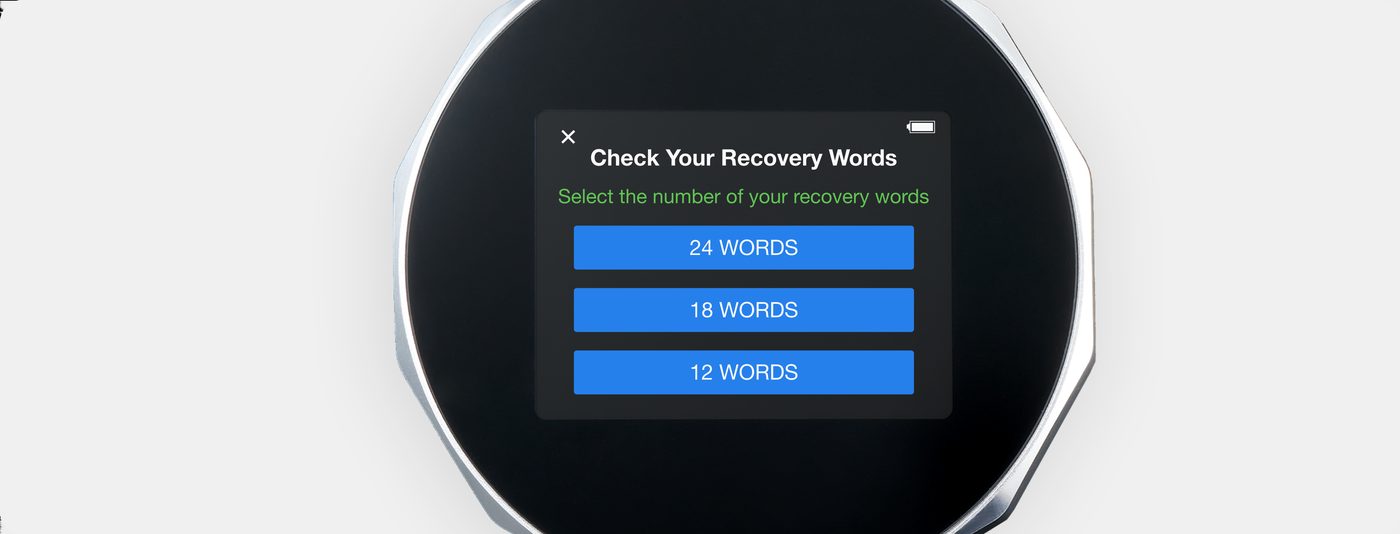
BIP-39 is the reason your wallet's recovery instructions look like a poem instead of a barcode. The proposal, published in 2013, solved a human problem: private keys are numbers a human cannot transcribe, memorize or verify, so it defined a reversible encoding into short dictionary words. Here's the full journey from randomness to keys, in plain language — the companion piece to our seed phrase storage guide.
Entropy: the number behind the words
When your hardware wallet "generates a seed", it's collecting randomness — measured as entropy, the raw unpredictability budget. A 12-word phrase encodes 128 bits of entropy; a 24-word phrase encodes 256 bits. The wallet gathers these bits from hardware sources (thermal noise, clock jitter) and, crucially, generates them on the device itself — a seed that came from anywhere else arrived with strings attached. What does 256 bits mean in practice? The number of possible seeds is 2 to the 256th power — more than the number of atoms in the observable universe by a factor you'd struggle to write down. Brute-forcing isn't a hard problem; it's a physical impossibility, which is why every attack you'll ever face targets the words' storage, not the words' math.
Why exactly 2048 words
Each word in your phrase encodes exactly 11 bits: 2048 possible values, because 2 to the 11th equals 2048. Twelve words times 11 bits gives 132 bits — of which 128 are your actual entropy and 4 belong to the checksum, which we'll meet in a moment. Twenty-four words give 264 bits: 256 of entropy plus 8 of checksum. The wordlist itself was curated so every entry is exactly four letters long (in English) and its first four letters are unique among all entries — "gol" only begins "gold". That's a transcription feature: you can write each word's first four letters and reconstruct the phrase, and ambiguous truncations are designed out. The list is sorted, which is why your words look alphabetically scattered — sorting them alphabetically is a classic catastrophic error, because order carries meaning.
The checksum: built-in typo detection
BIP-39 phrases verify themselves. Part of the final word doesn't encode entropy at all — it's a checksum computed by hashing all the entropy that came before. When you restore a phrase, the wallet recomputes that hash and compares: wrong word, swapped words, or a word not from the list produces an "invalid seed phrase" error. This is why your wallet refuses typos instead of silently generating a different (and empty) wallet — a design that has saved untold funds. It also means you cannot "make up" a valid-looking phrase from dictionary words and expect funds; random English sentences are rejected at restore time. The checksum is why the standard test in our first-week checklist works at all: wipe, re-enter, and the device itself tells you whether your paper matches your wallet.
From words to seed to keys
The words aren't the key material directly — they're a portable encoding of it. Restoration runs a defined pipeline. First, the phrase (plus an optional passphrase, if you use one) is stretched through PBKDF2 with thousands of hashing rounds, producing a 512-bit value called the master seed. The stretching is deliberate: it makes brute-force attempts at weak passphrases expensive. Then BIP-32, the hierarchical derivation scheme, turns that master seed into a tree of keys — one master key and, from it, practically unlimited child keys at known paths. Your Bitcoin account, your Ethereum addresses, every chain your wallet supports are branches of that one tree. This is why the words restore everything at once, and why an optional passphrase produces a completely different tree: change the 25th word, and every derived key changes with it — the mechanism behind the "decoy wallet" technique described in the seed guide.
Twelve words or twenty-four?
Both are secure against any realistic attack; 128 bits is already beyond brute force by any physical measure. The case for 24 words is margin-of-error: bigger entropy and a longer checksum (8 bits catches errors with 255-in-256 probability versus 15-in-16). The case for 12 words is transcribability: half the writing, half the entries to verify, half the opportunities for a copying mistake — and transcription mistakes, not mathematics, are where real losses happen. Our practical stance: use what your device defaults to, and spend the saved anxiety on storage and testing rather than bit-counting. The words' math was never going to be your problem.
The mistakes that matter
- Reordering the words. A set is not a phrase. The checksum usually catches it at restore — "usually" is not a word we like near life savings, so keep order sacred on paper.
- Writing lookalike four-letter prefixes carelessly. The truncated-first-four-letters trick is real, but only if you don't mix full words and truncations on the same page inconsistently.
- Assuming phrase compatibility across wallets. BIP-39 words restore on any standard wallet; funds appear where the derivation paths match. Coins "missing" after restore are almost always a derivation-path setting, not lost funds — check your wallet's path options before panicking.
- Entering the phrase anywhere except a device you control. The math doesn't care how convincing the website looked. Every "validator", "migration" and "support" form asking for words is the attack — see the fake-site guide.
Your 24 words are a number wearing a poem. The poem exists so a human can carry the number across years, fires and firmware changes — treat the paper accordingly.
Want to see the derivation for yourself without risking anything? Our upcoming tools suite includes an offline seed validator — meanwhile, the storage rules live in the seed phrase guide, and tested devices in the wallet reviews.